
History and interesting facts about Pena Palace
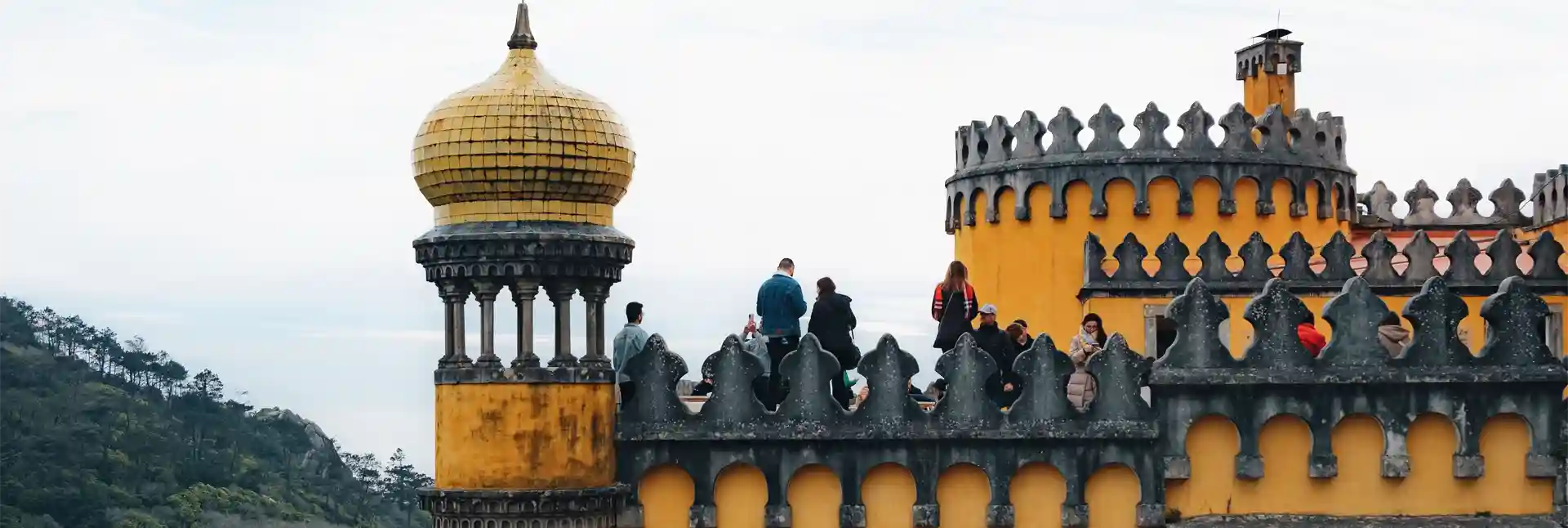
Pena Palace is one of Portugal’s most unique monuments. Its colorful appearance, location in the Sintra Hills and mixture of styles have made it one of the great symbols of European Romanticism.
Behind its almost theatrical appearance lies a long history, shaped by an ancient monastery, the 1755 earthquake and the artistic vision of Ferdinand II. Understanding this history allows you to see the palace from a different perspective during your visit.
If you want to discover the monument in person, you can check availability and book your tickets to Pena Palace to explore its rooms, terraces and park with an audio guide.
The origins of Pena Palace: from hermitage to monastery
The history of Pena Palace began long before the colorful building that dominates the hills today existed. A small hermitage dedicated to Our Lady of Pena originally stood on this elevated and secluded site.
Over time, the site was transformed into a Hieronymite monastery. This religious foundation shaped the original structure of the complex and explains why, even today, the cloister and chapel preserve traces of the palace’s monastic past.
The choice of the Sintra Hills
The Sintra Hills have always had great scenic and symbolic value. Their climate, vegetation and elevated position made them an attractive place for retreat and contemplation and, later, for the construction of residences associated with the royal court.
This setting explains part of the monument’s character. Pena cannot be understood as an isolated building: its history is closely linked to the landscape of Sintra and to the way each period interpreted the mountain.
The impact of the 1755 earthquake
The Lisbon earthquake of 1755 severely affected many historic buildings in Portugal, and the former monastery of Pena was also damaged. Although part of the structure survived, the complex lost its original function and became associated with a landscape of ruins.
This condition proved decisive for its later transformation. In the 19th century, medieval and monastic ruins attracted enormous interest among the Romantics, who saw them as an ideal starting point for creating a palace filled with history and fantasy.
Ferdinand II and the creation of the Romantic palace
Pena’s great transformation came with Ferdinand II, husband of Queen Maria II of Portugal. Fascinated by the site, he promoted the restoration of the former monastery and the construction of a new palace around it.
Ferdinand II is known as the Artist King because of his passion for art, architecture and landscape. His intervention transformed Pena into a highly personal cultural and aesthetic project, where Portuguese history interacts with European and Eastern influences.
A palace conceived as a work of art
Pena Palace does not follow a restrained or uniform architectural style. Its design combines towers, terraces, courtyards, arches, tiles, battlements and decorative references from different traditions.
This mixture is no coincidence. Romanticism valued emotion, imagination and the evocation of the past. For this reason, Pena was conceived as a habitable work of art, integrated into the landscape and filled with symbolic references.
The role of the park in the project
The park was a fundamental part of Ferdinand II’s project. Its paths, viewpoints, botanical species and decorative structures were designed to complement the palace experience and create a route filled with changing perspectives.
Today’s visit preserves this idea of a scenic walk. As visitors explore Pena Park, they discover corners designed to surprise, frame views and strengthen the relationship between architecture and nature.
A mixture of architectural styles
One of the most striking aspects of Pena Palace is its combination of styles. The building features Neo-Gothic, Neo-Manueline, Neo-Islamic and Renaissance influences, integrated into a highly eclectic composition.
This variety explains why the palace is so distinctive. Its forms do not seek to reproduce a specific historical period, but rather to create a Romantic vision of history, full of references, contrasts and decorative details.
Manueline and Portuguese influences
The Manueline style appears in elements linked to Portuguese artistic tradition. Arches, decorative motifs and certain details evoke a period associated with the Age of Discoveries and the country’s maritime splendor.
These references connect the palace with Portuguese historical identity. Within the complex, they help reinforce the national character of a monument that also draws inspiration from many other traditions.
Islamic and Eastern influences
Some areas of the palace incorporate arches, forms and motifs reminiscent of the Islamic heritage of the Iberian Peninsula. The influence of the Alhambra in Granada is particularly noticeable in certain entrances and decorative elements.
The Romantic fascination with the exotic explains this presence. At Pena, these influences add a theatrical and worldly dimension that reinforces the imaginative character of the building.
Color as a defining feature
The colors of Pena Palace are one of its defining features. Reds, yellows and other intense tones distinguish different volumes, areas and façades, creating an appearance that changes with the light, mist and distance.
More than a simple decorative element, color helps visually organize the complex. It also contributes to giving the palace the almost theatrical appearance that distinguishes it from other historic monuments.
Interesting facts about Pena Palace
Pena’s history is full of details that enrich the visitor experience. Some can be discovered on the façades and terraces, while others appear as you explore the interior or venture along the paths through the park.
The Triton, a figure between two worlds
The Triton Terrace is one of the best-known areas of the palace exterior. Its portico features a mythological figure that is half human and half marine creature, surrounded by plant and aquatic elements.
This composition perfectly captures the spirit of the palace: fantasy, literary references and a mixture of different worlds. The Triton acts as a symbolic guardian of the entrance to the New Palace.
A palace visible from different parts of Sintra
Pena Palace’s position high in the hills means that it can be seen from different parts of Sintra. Its silhouette stands out among the vegetation and changes in appearance depending on the distance and weather conditions.
Within the park itself, viewpoints such as Cruz Alta and Alto de Santa Catarina offer very different perspectives of the complex. You can find out more about these locations in What to see at Pena Palace: interior, terraces and park.
Pena Palace and the Moorish Castle share the same landscape
From several terraces of Pena Palace, you can see the Moorish Castle, also located in the Sintra Hills. This visual connection helps visitors understand the rich heritage of the area and the different historical periods represented within it.
While the castle evokes the region’s medieval defensive past, Pena represents the Romantic reinterpretation of the landscape. Visiting both monuments allows you to discover two very different periods in Sintra’s history.
A park designed to get intentionally lost in
Pena Park is filled with paths, lakes, viewpoints and small structures. Although it may appear to be a spontaneous natural space, its layout is the result of carefully considered landscape design.
Each turn is designed to alter the visitor’s perception: bringing the palace closer, hiding it among the trees, revealing a view or leading towards a symbolic corner. This planning makes the park an essential part of the monument’s history.
Pena Palace as a symbol of Sintra
Over time, Pena Palace has become one of the most recognizable images of Sintra. Its value goes beyond architecture: it brings together landscape, memory, imagination and heritage in a single monument.
Today, it forms part of the Cultural Landscape of Sintra, recognized by UNESCO, and remains an essential visit for understanding the identity of the region. If you are planning your trip, you can also consult How to visit Pena Palace: tickets, opening hours and tips.
Why it is worth learning about its history before your visit
Learning about the history of Pena Palace helps you better understand what you see during your visit. Its colors, terraces, courtyards and rooms are not isolated elements: they are all part of the same Romantic vision of art and landscape.
The visit becomes much richer when you understand the evolution of the site: from hermitage to monastery, from ruin to royal residence and from Romantic palace to icon of Sintra. This transformation explains why Pena remains one of Portugal’s most fascinating monuments.