
What to see at Pena Palace: interior, terraces and park
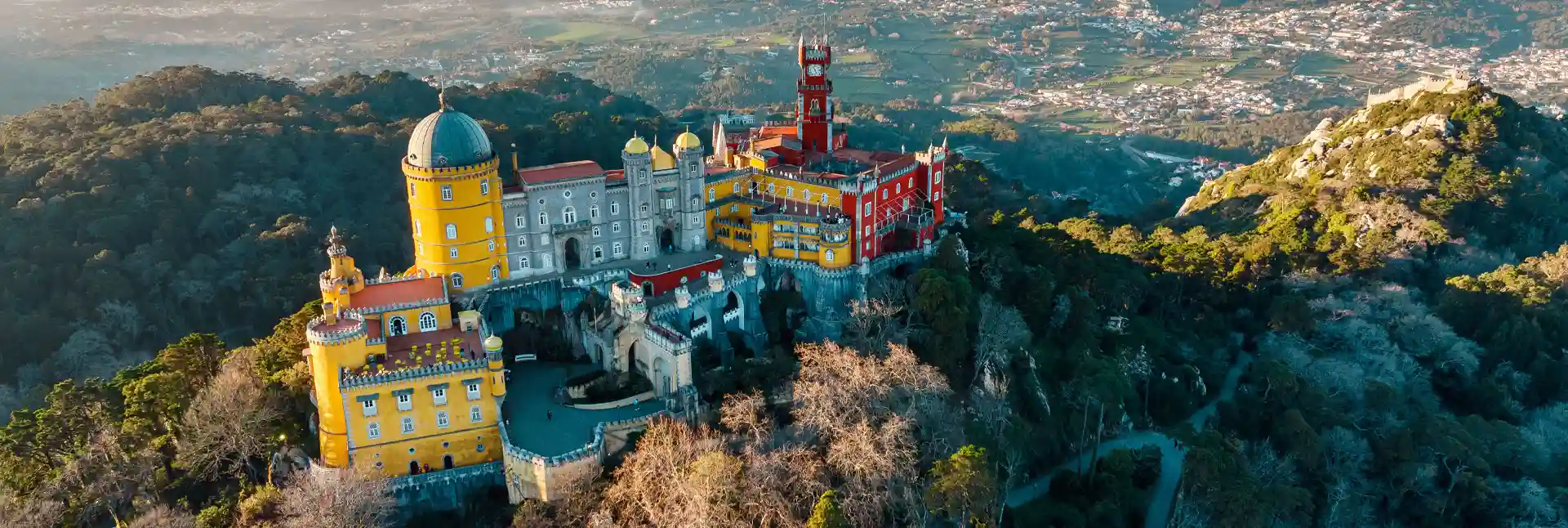
Pena Palace is one of Sintra’s most recognizable monuments and one of the great icons of Portuguese Romanticism. Its colorful silhouette, its position high in the hills and the landscape surrounding it make a visit one of the most complete experiences in the region.
The visit combines very different spaces: historic rooms, decorated courtyards, panoramic terraces, walkways and a park designed as a landscaped garden. For this reason, it is useful to distinguish between the interior of the palace, its viewpoints and the route through the park before planning your itinerary.
If you are preparing your visit, you can check availability and book your tickets to Pena Palace to explore the monument with an audio guide and better plan your time inside the complex.
What to see inside Pena Palace
The interior of Pena Palace reveals how a former Hieronymite monastery was transformed into a royal residence. The route preserves private quarters, reception rooms and decorative details that showcase the mixture of styles that characterizes the monument.
The Manueline cloister
The Manueline cloister recalls the monastic origins of the building and is one of the spaces that best connects the Romantic palace with its earlier history. Its arches, tiles and proportions reveal the most intimate and secluded part of the complex.
Around it are former rooms that were adapted for use by the royal family. This overlap between monastery and palace helps explain why Pena does not belong to a single period or architectural style. You can learn more about its historical context in History and interesting facts about Pena Palace.
The private apartments
The private apartments offer an insight into the everyday use of the palace as a residence. Bedrooms, studies, sitting rooms and service areas reveal a more domestic side of the monument, far removed from its more theatrical and monumental exterior.
These spaces help visitors imagine life at Pena during the final centuries of the Portuguese monarchy. Furniture, wall coverings and decorative objects reveal a palace designed to be lived in, not merely admired from the outside.
The Great Hall
The Great Hall is one of the most representative rooms in Pena Palace. It was designed as a reception space and stands out for the overall effect created by its ceilings, walls, lamps and works of art.
As you walk through it, the palace’s aesthetic ambition becomes clearer: this is not an isolated room, but a key part of the Romantic project promoted by Ferdinand II.
The chapel
The chapel preserves the religious heritage of the former convent and provides an important contrast within the visit. Unlike the palace rooms, this space retains a more symbolic and contemplative character, connected to the spiritual origins of the site.
Its presence is a reminder that Pena Palace developed from an earlier structure. This continuity between convent, residence and monument is one of the keys to understanding the historical evolution of the complex.
The palace kitchen
The kitchen reveals a more functional side of life in the palace. Its utensils, fireplaces and working areas show how the extensive services associated with the royal residence were organized.
Although it does not have the spectacular appeal of the terraces, it is a worthwhile stop that completes the visit. It helps visitors understand the everyday scale of a building designed to accommodate stays, receptions and celebrations.
Terraces and viewpoints at Pena Palace
The terraces are one of the main reasons to visit Pena Palace. From them, you can admire the colors of the façade, the outline of the hills, the Moorish Castle and the landscape stretching towards Lisbon and the Atlantic.
The Queen’s Terrace
The Queen’s Terrace offers one of the widest views of the complex. From this point, you can see the park, the hills and several features of the Sintra landscape, with a privileged perspective over the palace’s natural surroundings.
It is one of the best places to stop during your visit, as it allows you to appreciate the relationship between the building and the surrounding landscape. The experience becomes more meaningful when you understand that Pena was conceived as a palace integrated into a scenic landscape.
The Triton Terrace
The Triton Terrace marks the entrance to the so-called New Palace and features some of the most striking details of the exterior. The gateway combines marine, botanical and fantastical references in a composition that is highly characteristic of the Romantic style.
The Triton, a figure that is half human and half marine creature, serves as both a symbolic and decorative element. Paying attention to this entrance helps you understand the imaginative and almost theatrical nature of Pena’s architecture.
The Courtyard of the Arches
The Courtyard of the Arches is another of the palace’s most photogenic spaces. Its arches frame the landscape and create a direct relationship between architecture and views, one of the recurring themes throughout Pena Palace.
From this point, you can clearly appreciate the contrast between the colors of the building and the surrounding hills. It is a recommended stop for observing how the palace uses courtyards, terraces and open spaces to frame views of the landscape.
The wall walk
The wall walk allows you to explore part of the palace’s exterior perimeter and see it from a different perspective. This area reinforces the fortified appearance of the complex, although its purpose is more scenic than defensive.
Walking along this section allows you to admire the Moorish Castle and the hills from an elevated position. If you want to combine both monuments on the same day, you can consult the guide What to see in Sintra: Pena Palace, Moorish Castle and National Palace.
What to see in Pena Palace Park
Pena Palace Park is not simply an access route to the building. It is an essential part of the experience and was designed as a large Romantic garden with winding paths, botanical species, viewpoints and hidden corners intended to create a sense of surprise during the walk.
Cruz Alta
Cruz Alta is one of the highest points in the Sintra Hills and offers one of the most complete panoramic views of the palace. From here, you can better appreciate the building’s commanding position within the landscape.
Reaching this viewpoint requires some time and effort, but it can be worthwhile if you want to see Pena from a different distance. The reward is one of the most recognizable views of the palace surrounded by vegetation.
The Temple of Columns, the Warrior and the Queen’s Table
The Temple of Columns stands out among the trees thanks to its circular structure and yellow dome. Nearby is the statue of the Warrior, a figure associated with the Romantic imagery of the park.
The area also includes the so-called Queen’s Table, one of the spots associated with the royal family’s life at Pena. These elements demonstrate how the park combines architecture, sculpture, vegetation and small symbolic settings.
The Monk’s Grotto and Alto de Santa Catarina
The Monk’s Grotto evokes the religious past of the site and serves as a secluded retreat within the park. Alto de Santa Catarina, also associated with the memory of Queen Amélia, offers a special view of the palace.
These areas are particularly interesting because they take visitors away from the busiest parts of the site and allow them to discover the more scenic and contemplative side of Pena Park.
The Valley of the Lakes and the Fountain of the Little Birds
The Valley of the Lakes offers a more peaceful side of the park, with paths, water and vegetation. It is an ideal area for extending your visit beyond the palace and its terraces.
The Fountain of the Little Birds and the surrounding areas help visitors understand the park as a sequence of small scenes. At Pena, every detour can reveal a viewpoint, a decorative structure or a change in scenery.
How to organize your visit to Pena Palace
A simple way to organize your visit is to begin with the interior of the palace during your reserved time slot and then spend time exploring the terraces and park. This helps you avoid missing access to the section with a scheduled entry time while leaving the outdoor areas for the more flexible part of your visit.
It is advisable to arrive with plenty of time, as there may be some distance, uphill walking and crowds between the park entrance and the palace. To plan your day more effectively, you can find further information in How to visit Pena Palace: tickets, opening hours and tips.
The best places to view and photograph Pena Palace
The palace’s own terraces allow you to capture details of the façade, its colors and its relationship with the surrounding hills. The Courtyard of the Arches, the Triton Terrace and the Queen’s Terrace are some of the most interesting places to observe the building from within the visitor route.
Outside the palace, viewpoints such as Cruz Alta and Alto de Santa Catarina offer wider perspectives of the complex. The light, Sintra’s frequent mist and the surrounding vegetation mean that the appearance of Pena Palace can change considerably depending on the time of day and weather conditions.
Choosing carefully what to see at Pena Palace will help you make the most of a visit that is exceptionally rich in detail. The interior, terraces and park form an inseparable whole: only by exploring all three can you fully understand why Pena is one of Sintra’s great symbols.